
About Fog
Fog is the suspension of very small water droplets in the air that reduces surface-based visibility. Some of the more common types are radiation fog, advection fog, upslope/terrain-induced fog, rain/post-frontal fog, blocked flow fog/stratus, and valley fog. This lesson focuses on radiation fog, which affects many tropical regions, including Eastern Africa.
Radiation fog is caused by nocturnal infrared cooling at or near the ground surface. It forms and completes its life cycle in situ (although it can be advected under the right conditions). The key low-level ingredients required to generate radiation fog are moisture (high relative humidity), rapid cooling, and calm or light winds (generally 5 kt or less), as shown in the graphic below.
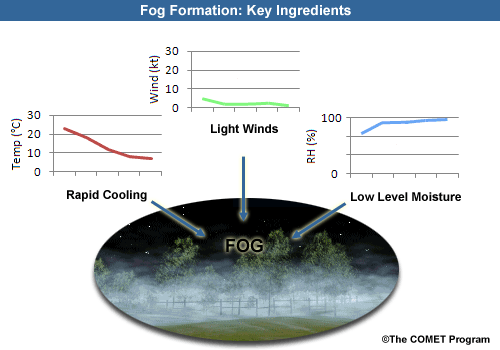
Additional characteristics of radiation fog include:
Duration |
Generally short duration (< 24 hr), often dissipating by afternoon |
Intensity |
Considerable variation, especially over open areas or near water sources where fog tends to be denser; dense areas may be isolated but can present an aviation hazard |
Coverage |
Typically remains in one place, and is patchy and localized |
Depth |
Varies with the depth of the radiation inversion |
Time of Day |
Tends to form late at night or in early morning hours; can also form after precipitation that clears near or after sunset |
Fog typically dissipates within a few hours with increasing wind, cloud cover, advection of drier air, and/or solar radiation.
For more information on the various types of fog, access the COMET lesson Fog: Its Processes and Impacts on Aviation and Aviation Forecasting at http://www.meted.ucar.edu/fog_int/navmenu.php?tab=1&page=4.0.0.