OCCLUSION: WARM CONVEYOR BELT TYPE
written by ZAMG
METEOROLOGICAL PHYSICAL BACKGROUND
As has been explained in the general remarks the starting viewpoint
for the conceptual model OCCLUSION: WARM CONVEYOR BELT TYPE is the typical
configuration in the satellite imagery and its development up to an eventually
longer lasting mature stage.
CLASSICAL NORWEGIAN MODEL
The classical development of an occlusion is described in the well-known polar
front theory after Bergeron as a development from a wave stage
(compare also chapter WAVE
 WA
)
with a well developed cold front
(compare also chapters of COLD FRONT
CF
CC
CW
SF
AC
)
and warm front
(compare also chapters of WARM FRONT
WB
WS
WF
).
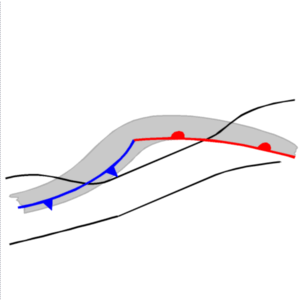
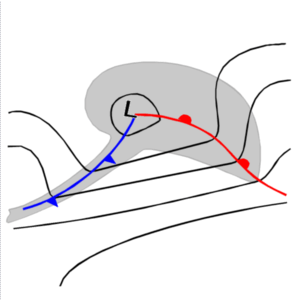
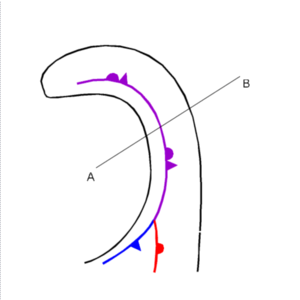
The basic idea is that the cold front moves faster than the warm front. Therefore
the warm sector continously becomes more narrow until finally the cold front
overtakes the warm front completely, thereby lifting the warm air. This is the
typical situation for the occlusion band which turns cyclonically around the core
of the cyclone.
WA
)
with a well developed cold front
(compare also chapters of COLD FRONT
CF
CC
CW
SF
AC
)
and warm front
(compare also chapters of WARM FRONT
WB
WS
WF
).
The basic idea is that the cold front moves faster than the warm front. Therefore
the warm sector continously becomes more narrow until finally the cold front
overtakes the warm front completely, thereby lifting the warm air. This is the
typical situation for the occlusion band which turns cyclonically around the core
of the cyclone.
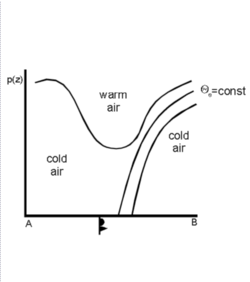
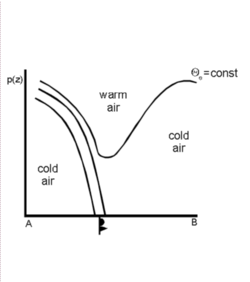
According to this classical theory of the occlusion band, this front separates the
cold air mass, which is situated in front of the former warm front, from that
behind the former cold front with a tongue of warm air within the higher levels
of the troposphere
(compare
typical appearance in vertical cross section).
Following the distribution of the temperature in front of and behind the
occlusion, two sub-types can be separated:
- If the air situated in front of the warm front has about the same
temperature as the air situated behind, the temperature gradient
dissolves during the process of the occlusion. In this case the
occlusion is characterized only by a line of cyclonic shear and
convergence which can be found vertically below the merging point of
both fronts.
- If the air situated in front of the warm front is colder than the air
behind, a so-called warm front occlusion develops which has a
forward inclined frontal surface.
- If the air situated in front of the warm front is warmer than the air
behind, a so-called cold front occlusion develops which has a
backward inclined frontal surface.
|
CROSS SECTION |
|
|---|
| WARM OCCLUSION |
- |
| COLD OCCLUSION |
|---|
During this process, the displacement of the low becomes smaller, until
it becomes quasi-stationary.
DEVIATIONS BETWEEN CLOUD CONFIGURATIONS IN SATELLITE IMAGES AND
CLASSICAL NORWEGIAN MODEL
Very soon after the use and study of satellite images it became clear that this
idealized theory cannot be observed in every step and detail in reality.
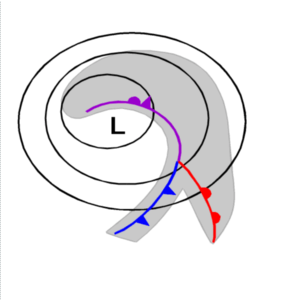
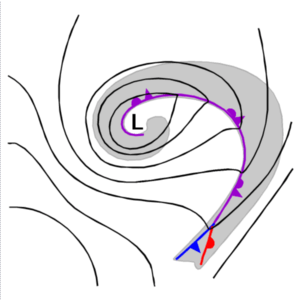
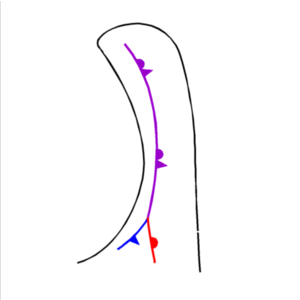
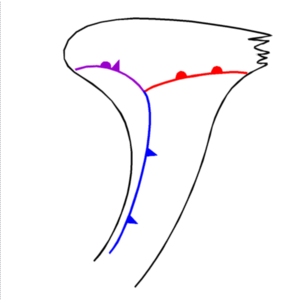
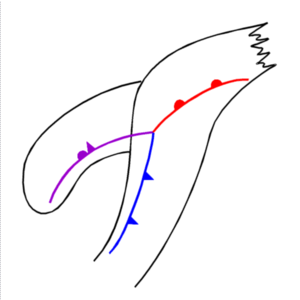
In particular, the overtaking of the warm front by the cold front with very
narrow warm sectors can never be seen (left schematic). Instead of this a
mergence of cold and warm front cloudiness in the centre of the surface low
takes place followed by a westward extension of the occlusion cloud spiral, while
the warm front cloudiness becomes shorter (right schematic).
Beside this there are occlusion spirals which contradict the overtaking mechanism
completely. Those developments show a lower cloud spiral penetrating westward
from below the cold front and warm front.
As already mentioned for cold fronts and warm fronts, those contradictions
between the typical polar front theory and the appearance in the satellite imagery
were also one reason for the conveyor belt theory.
CONVEYOR BELT MODEL
This theory is not an independent new model, but allows a different insight
into the same phenomena of the occlusion process. It shows a much bigger
variety of development possibilities and clearly indicates that the occlusion
development described by the Norwegian model represents only a special
case.
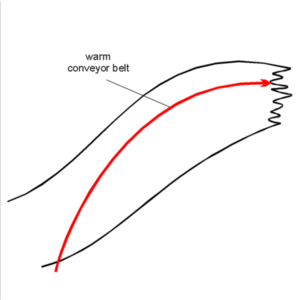
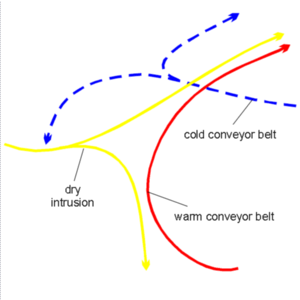
The conveyor belt theory for the cold front deals predominantly with two relative
streams: the warm conveyor belt and the dry intrusion. The warm front deals
predominantly with the relative streams of the warm conveyor belt and the cold
conveyor belt. For the occlusion all three conveyor belts are relevant:
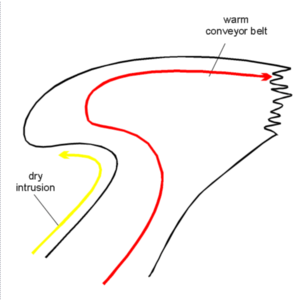
- The warm conveyor belt is a rising relative stream from south,
south-eastern directions turning to north, north-eastern directions; it
transports warm and moist air.
- The dry intrusion is a sinking relative stream from north-west to
south-east, splitting into two branches: a further sinking one to the
south-west and a rising one to the north-east.
- The cold conveyor belt is a rising relative stream from east,
south-east which is initially below the warm conveyor belt, but then
emerges from below and extends to northern directions.
The vertical relation of these three conveyor belts to each other results in
the different cloud types of the occlusion: the multilayered warm conveyor belt
type of the cloud spiral and the cold conveyor belt type.
The structure and formation of the cloud spiral of the warm conveyor belt
occlusion type can also be described with the conveyor belt theory as follows:
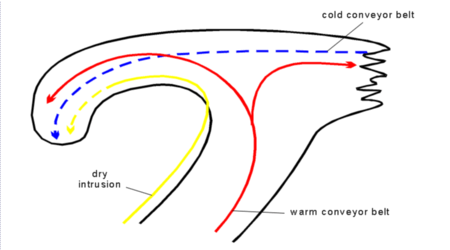
- An ascending cold conveyor belt can be found parallel to the surface
warm front. At the point of the occlusion it penetrates from below the
warm conveyor belt and turns cyclonically forming the cloud spiral. The
relative stream of the cold conveyor belt is a main relative stream
forming the occlusion cloud band. In this occlusion type it is
hidden below higher level cloudiness which is related to the middle and
upper level streams. Within the cyclonic turn the ascending motion
changes into a descending motion which causes the decrease of the frontal
cloud tops.
- The higher levels of the troposphere are characterized by the relative
streams of the warm conveyor belt and the dry intrusion. The
configuration of the warm conveyor belt depends on the stage of
development. In the early wave stage the warm conveyor belt ascends
within the cloud band of the cold and warm front where it turns
anticyclonically parallel to the surface warm front
(compare also chapter WARM FRONT BAND
WB
).
During the warm conveyor belt type of the occlusion development, described
in this chapter, the warm conveyor belt develops to a ridge-like hook over
the occlusion band and later on splits into two parts: the eastern branch
follows the cloud band of the warm front while on the western branch it
follows the cloud spiral of the occlusion. This is the main difference
to the cold conveyor belt occlusion type, because in the warm conveyor
belt cloudiness develops and forms the multilevel occlusion cloud band.
The cloud bands of the warm and the cold conveyor belt are often
distinct.
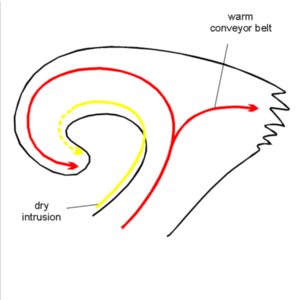
- The dry intrusion is accompanied by descending air originating from the
upper levels of the troposphere and/or the lower levels of the
stratosphere. The dry intrusion is approximately to the rear cloud edge
of the cloud spiral of the occlusion. If at all it overruns only the
boundary zones of the cloud band. These are the areas predestined for
the development of Cb cloudiness, which often can be observed in the
images
(compare
cloud structure in satellite image)
as well as in the synoptic weather reports
(compare
weather events).
The following reasons for the convective development can be found:
- the air advected within the dry intrusion has lower values of
relative humidity than the air of the cold conveyor belt;
this leads to the development of a conditionally unstable
stratification;
- a PVA maximum indicating moving curvature vorticity contributes
to upward motion according to the omega equation.
- The fact that the dry intrusion does not cross the occlusion cloud band
in this warm conveyor belt development type is another big difference from
the cold conveyor belt type
(compare also chapter OCCLUSION: COLD CONVEYOR BELT TYPE
CC
).


A comprehensive study at ZAMG of all occlusion events during one year shows many
of the mentioned points described above, but also some deviations. These facts
can be summarized as follows:
- Classical occlusion developments like the one described in this chapter
occur rather seldom.
- In every case a cold conveyor belt, as described above, could be
observed.
- Whether a warm conveyor belt occlusion type or a cold conveyor belt
occlusion type develops seems to depend on the stage of development of the
cyclone. If the height field in the mid- and upper levels of the
troposphere displays a closed cyclonic circulation, the warm conveyor belt
occlusion cloud spiral characterized by multilevel cloudiness is likely
(compare
key parameters).
This is another difference between the two types of occlusion
(compare also chapter OCCLUSION: COLD CONVEYOR BELT TYPE
CC
)
and could be a tool for an early discrimination.
- The behaviour of the warm conveyor belt is very similar to the one
described above with one exception: while the hook form of the warm
conveyor belt can clearly be observed, the splitting into two branches
never appeared.
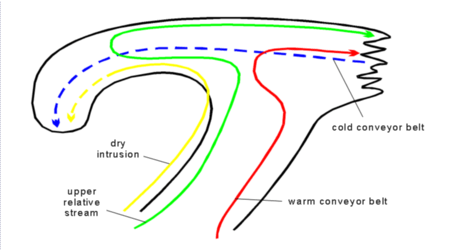
- As described for the cold front, not only is the warm conveyor belt
responsible for the cold and warm front cloudiness, but also the upper
relative stream transporting moist air at the anticyclonic side of the
jet. Consequently the upper relative stream is also involved in the
occlusion process. For the higher isentropic surfaces it is even the
more dominant and important relative stream. Like the warm conveyor belt
within the mid-isentropic surfaces, the upper relative stream also
develops a hook form in the upper tropospheric surfaces. A splitting
during the mature stage of development could not be observed.
- The configuration of the dry intrusion could also be observed, as well as
the area with convective development. But the course of the stream lines
of the innermost part of the cloud spiral could not clearly be
distinguished; very often it overruns the cloud spiral.
- It has to be stressed that in a high percentage of cases the initial
stage of an occlusion process has cold conveyor belt features even if a
multilevel cloud spiral soon develops.
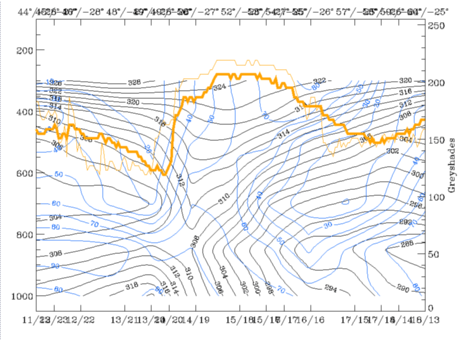
21 October 1996/18 UTC - vertical cross section; lines: black: isentropes of
THETAE, blue: relative humidity, orange: IR (thin) and WV (thick)
signal
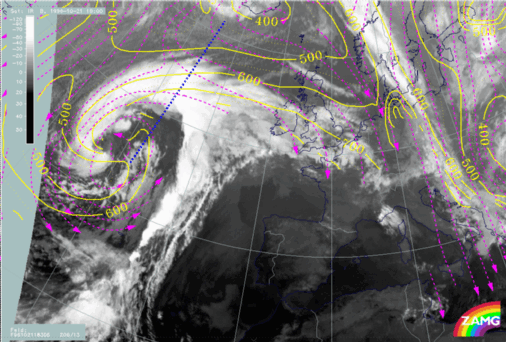
21 October 1996/18 UTC - IR image; relative streams on the isentropic surface
of THETAE = 305 K; lines: yellow: isobars, magenta: relative
streams - system velocity: 206° 13 m sec-1, dashed blue:
position of vertical cross section
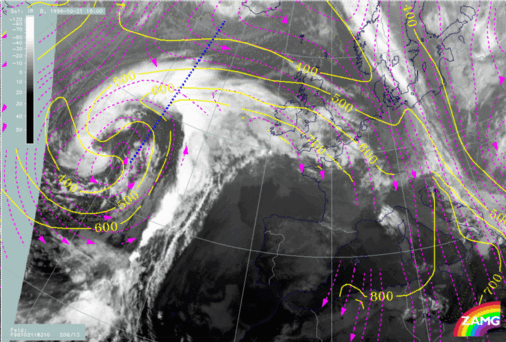
21 October 1996/18 UTC - IR image; relative streams on the isentropic surface
of THETAE = 310 K; lines: yellow: isobars, magenta: relative
streams - system velocity: 206° 13 m sec-1, dashed blue:
position of vertical cross section
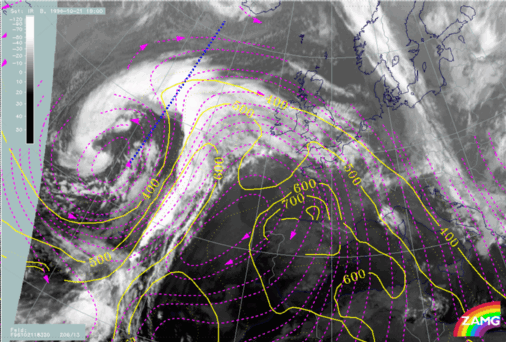
21 October 1996/18 UTC - IR image; relative streams on the isentropic surface
of THETAE = 320 K; lines: yellow: isobars, magenta: relative
streams - system velocity: 206° 13 m sec-1, dashed blue:
position of vertical cross section
In the vertical cross section, which extends in the Atlantic from approximately
44°N/28°W to approximately 60°N/25°W, the isentropic surface
of 310 K is a surface within the occlusion cloud band. Both relative streams
on this surface cut the cross section perpendicularly at about 650 hPa. This is
an area of high humidity for the cold conveyor belt, but an area of high
humidity gradient for the dry intrusion.
On the isentropic surface of 305 K the cold conveyor belt can be observed within
the cloud spiral.
A cold conveyor belt can still be observed on the isentropic surface of 310 K but
the innermost parts of the cloud spiral are already overrun by the dry intrusion.
On the isentropic surface of 320 K the hook form of the upper relative
stream accompanies a large part of the occlusion cloudiness. For this the
assumption has to be made that the zero line of shear vorticity does not cut
the cloud band as computed by the numerical model, but follows the rear cloud
edge and is connected to the western zero line of the shear vorticity.
 HELP - I AM LOST
 MAIN MENU OF THE MANUAL
-
SUB-MENU OF THE OCCLUSION: WARM CONVEYOR BELT TYPE
 FIRST SUB-CHAPTER - CLOUD STRUCTURE IN SATELLITE IMAGE
 THIRD SUB-CHAPTER - KEY PARAMETERS
Copyright ZAMG