

 CF
).
CF
).
But there are many cases where frontal cloud bands appear in areas of WA with the zeroline of WA far ahead; nevertheless there exists a typical frontal thickness gradient and consequently a well developed TFP. In the first instance such a situation contradicts somewhat the classical processes taking place at fronts.
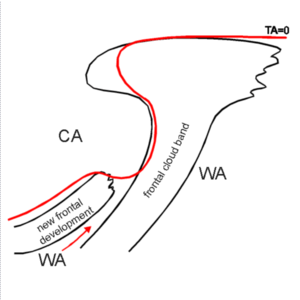
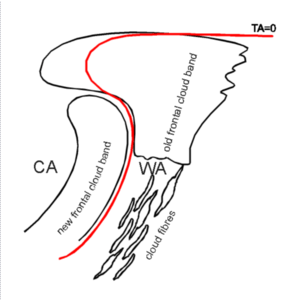
One typical situation for such a development is connected with the development of a secondary front (or baroclinic boundary) at the rear side of the main front. In front of the new, secondary front warm air is advected north-eastward and consequently after some time of development it is superimposed on the old main front. This leads to a decrease of the temperature contrasts at the first front and consequently to a decrease of frontal conditions there. At the same time frontal conditions are strengthened at the second, new frontal cloud band.
Such a situation is a sign for a beginning of dissolution of cloudiness.
Consequently the conceptual model of the cold front in warm advection
indicates a frontal cloud band which is not very weather-active and even
decreases during the following period.
|
|
17 November 1997/12 UTC - IR image; lines: blue: thermal front parameter (TFP)
500/850 hPa, red: temperature advection 500/1000 hPa
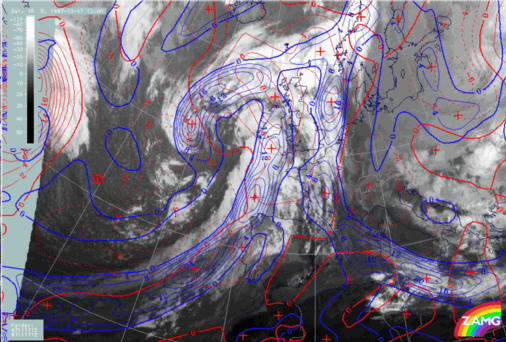
The satellite image shows the cloud band of a cold front in warm advection
extending from south-west France across the North Sea to the Atlantic (approximately
69°N/12°W). Behind the cold front in warm advection the new approaching
cold front can be observed from the Atlanitc west of the Iberian Peninsula to
Ireland.
|

|
 HELP - I AM LOST
 MAIN MENU OF THE MANUAL