 Irregular assistance, as lectures are not compulsory;
First Experiences
Application of dynamic simulation models to teach the balance of radiation
Characteristics of the student sample
The first experience was carried out in a Course of Bioclimatology composed by 12 students. The student sample exhibited similar characteristics compared to those of previous courses:
Irregular assistance, as lectures are not compulsory;
Adaptation to a passive role within a traditional framework of education, with expositive theoretical classes and exercise ones in which problems are solved;
A negative attitude to mathematical formulations, therefore the learning process is perturbed by the traditional education based on the use of mathematical equations;
A resistance to recognize as previous knowledge the concepts originated from everyday-life experiences as well as those acquired in previous studies. Most of the students have taken at least a course of Ecology.
These attitudinal characteristics in conjunction with those abilities related failures (a poor physical-mathematical command and the ignorance of programming languages) suggested that dynamic simulation models could represent a useful tool to achieve the general objective of the Course of Bioclimatology.
This objective can be stated as: Acquire a learning scheme that allows to recognize and comprehend, in a global way, the different processes that take place within the atmosphere, distinguishing which are the internal and external variables that interact and how they work.
These models are developed using dynamic systems software, it is possible to:
Elaborate a computational model with no need of previous programming skills;
Give priority to the physical aspects of the model;
Make use of mathematical expressions as tools;
Use the trial-error technique;
Have numerous quantitative results that allow analyzing by comparison the impact of different system components without tedious manual calculations.
Class development
The use of different techniques was necessary to propitiate the achievement of the course general objective, permitting an attitudinal change of the students. The academic objectives were presented, students were asked about their own with the intention of reaching a common one for the whole group. They were always encouraged to participate and to work in groups. In this way, the student begins to feel as the essential main character of the teaching-learning process.
The introductory module of the course of Bioclimatology contains numerous concepts that the students possess. Therefore, they were encouraged to participate by the means of techniques like "brainstorming" starting from everyday-life experiences and "confrontation of ideas". The role of the teacher was to guide the activity and to evaluate each individual intervention, independently of the fact it was correct or erroneous. These activities help the student to recall and appraise their own and anybody else’s previous knowledge.
Solar radiation is the first interaction between the Earth System and the Universe that the students openly recognize. Therefore, they were faced to a concrete problem " How much radiation reaches the surface of the Earth? ". They were requested to individually answer using a sketch. Then, the discussion in small groups was proposed, arriving gradually to a general discussion and obtaining a first approach of the problem solution. The figures illustrate some of the individual sketches.
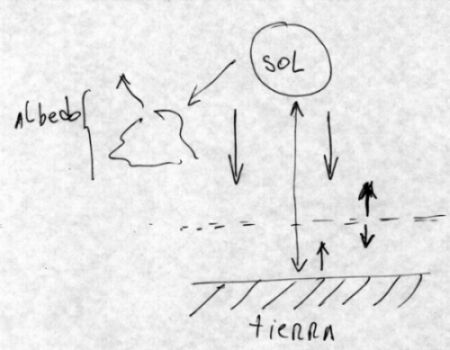
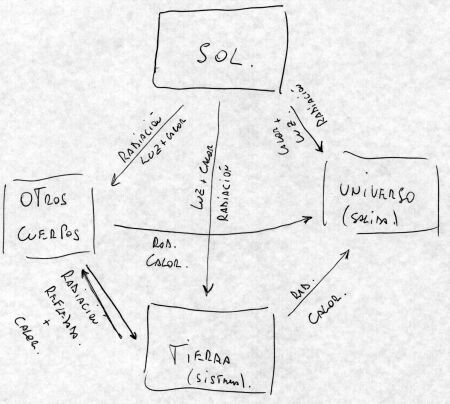
Through the use of "concrete models", they were persuaded to introduce the parameters involved in temporal and spatial variations that had not been included. Finally, the software was presented, designing a small simulation model to determine the solar constant to exemplify its usage, and the development of their model for radiation balance was proposed. Work on computers has been done in cooperative pairs. Along with the scenery modification when switching from the classroom to the computational lab, the following attitudinal changes have been observed:
A greater discussion between students and with the teacher;
An increment in the students’ cooperation;
An enhanced motivation reflected in increased levels of assistance.
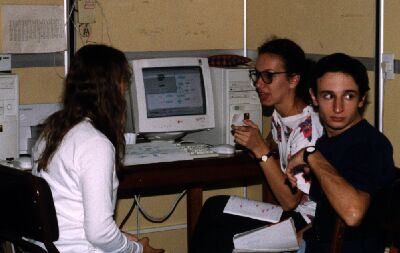
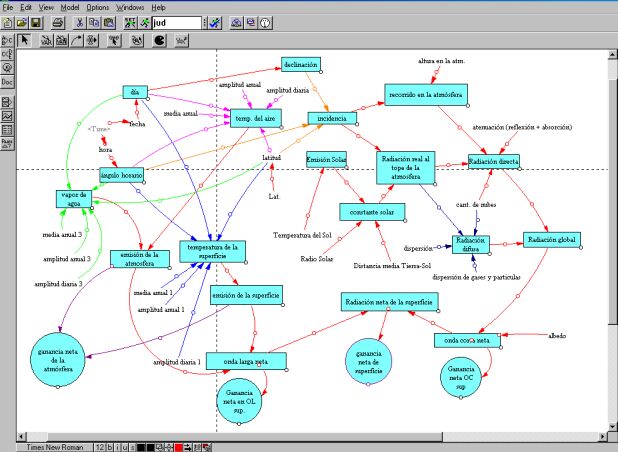
It was also remarkable the ease with which the students operated the software. Finally, the mathematical formulations representing quantitatively the designed conceptual model have been presented. At the same time, they were requested to answer a questionary, basing their answers on the acquired knowledge and contrasting them with the results of the application of the simulation model. The final version of the radiation balance model is shown in the following figure.
Questionary
1.- How does the surface direct radiation behave during the year at different latitudes?
2.- How does the surface diffuse radiation behave during the year at different latitudes?
3.- How does the net long wave radiation at surface behave during the year at different latitudes? And, within the atmosphere?
4.- During the year, at the same latitude, Will the surface gain, lose or find a an equilibrium of radiation?
5.- During the year, at the same latitude, Will the atmosphere gain, lose or find equilibrium of radiation?
6. For the same latitude, a) How does the albedo affect?, b) How does the atmospheric pollution?, c) And how does the cloudiness?
The initial answers exhibited comprehension difficulties, and a scarce link between the concepts applied for the model development and the resolution of the proposed problem. It must be noted that, traditional problem guides, generally, suggest the variables to be considered for resolution and, indirectly, those processes that would be involved. These guides tend to be organized according to an increasing level of difficulty and treating each process in different exercises to reduce the number of calculations. In this way, within a traditional education framework, the students hardly achieve to link all the processes and accomplish an abstract representation of the system complexity.
By using the software to design the radiative model, the students could estimate this complexity that, initially made difficult for them to isolate the individual effects of each fundamental variable. However, a further treatment of surface balance of energy and general circulation of the atmosphere as restoring mechanisms of the Earth system, in the classroom, showed a participating group, that included the previous knowledge to the discussion, and proposed "individual theories" for the resolution of the "unexpected "misbalance observed during the simulations.
Conclusions an preliminary suggestions
The results of this first experience suggest that:
The traditional teaching method would perturb the use of new didactic strategies with groups that have developed their cognitive processes within this scheme;
The students would exhibit a certain resistance to new techniques as they should modify their study method and cognitive process;
The students would present a strong sensitivity to the scenario at which the classes take place; Along with the scenery modification when switching from the classroom to the computational lab, the following important attitudinal changes have been observed:
- A greater discussion between students and with the teacher;
- An increment in the students’ cooperation;
- An enhanced motivation reflected in an increased level of assistance.
The baseless and constant fear to be evaluated would inhibit the participation of the students;
The students would be encouraged to recognize and appraise their previous knowledge;
The students seem to face a concrete problem under a punctual and static scope;
The nature and dynamics of the teaching-learning process faced with dynamic simulation models implies an almost personalized dedication of the teacher to each student; therefore it would be convenient to unify the theoretical and exercise classes, increasing the number of teachers and improving the academic coordination;
The simulation model should be gradually designed, incorporating each new process after the student had experienced enough with the previous one;
The time required for the student to adequately conceptualize the different processes involved in the radiative balance, seems to be longer that stipulated curricular designs;
The set of applied techniques seems to be effective in relation to the achievement of the attitudinal, conceptual and procedural related objectives. The further treatment of surface balance of energy, and general circulation of the atmosphere as restoring mechanisms of the Earth system, in the classroom, showed a participating group, that included the previous knowledge to the discussion, and proposed "individual theories" for problems resolution.
The results of this first experience allowed detecting the benefits and difficulties of the application of dynamic simulation models. It will allow designing a more adequate teaching strategy. The preliminary conclusions will be tested in future experiences.

