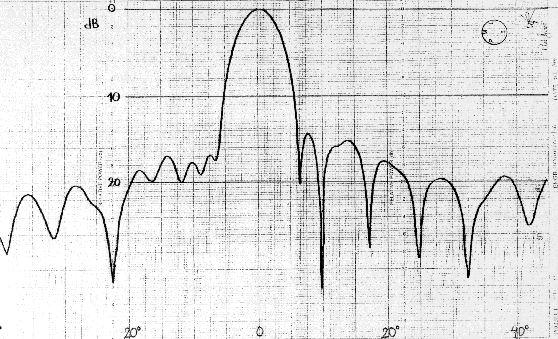
Energy transmitted by a typical modern radar antenna. 0 marks the axis ("where radar is pointing"). Between -0.5 and 0.5 is the main lobe. Off to the sides, six sidelobes are seen.
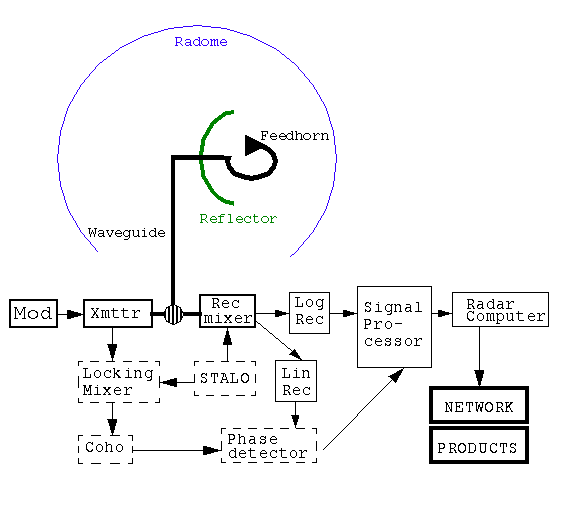
No matter what kind of transmitter is used in the radar, it is usually controlled by another electronic device called the modulator. The purpose of the modulator is to switch the transmitter on and off and to provide the correct waveform for the transmitted pulse. That is, the modulator tells the transmitter when to transmit and for what duration.
Actually, there is another device which is not shown on Fig. 2.1 that controls the entire radar system. This is sornetimes called the master clock. It determines how often the radar will transmit a signal into space. The master clock can also be used to control other parts of a radar such as the display system and the signal processors used on modern weather radars. Trigger pulses control timing and onset of switches.
The rate at which the radar transmits is called the pulse repetition rate or pulse repetition frequency (PRF) and is usually measured in pulses per second or transmitter cycles per second; PRF is often designated in hertz (where 1 Hz = 1 cycle/second). Older, conventional ground- based weather radars used to operate with PRFs on the order of 150 to 600 Hz. More modern (Doppler) weather radars -- capable of detecting the speed of targets moving toward or away from the radar -- typically operate with PRF's of 200 to 1500 Hz. Weather radars used on board aircraft operate at perhaps 500 to 1500 Hz.
The duration of the transmitted signal goes by either of two different names. If measured in units of time, we call it the pulse duration, if measured in units of distance, we call it pulse length (h). Typical pulse durations are from 0.1 to 10 x 10 -6 s (microseconds).
The only S-band radar in Scandinavia is in Karup, Denmark.
* 5.6 cm wavelength (C-band, 5.3-5.7 GHz)
In recent years it has been realised that this wavelegth offers the best compromise for
meteorological purposes and is now used for most new radars in non-tropical regions.
Transmission at this wavelegth has the ability to penerate medium-intensity precipitation and,
when used with data processing systems, attenuation correction algorithms can be
incorporated.
Most Scandinavian radars are C-band.
* 3.0 cm wavelength (X-band, 9.3-10.0 GHz)
Transmission at this wavelength is heavily affected by attenuation e.g. in radar and hail. Radars
operating at this wavelength are generally dedicated to urban hydrological applications, which
require very high spatial resolution with limited range. Also in this case, carefully developed
procedures for attenuation correction must be integrated in the processing system.
Rovaniemi radar in Finland is an X-band radar.
Transmitted microwave pulse power Pt is assumed to be very stable in the modern radars. Powers are often expressed in dBm units; 1 dBm = 10 log (power in watts / 1 mW).
An antenna that sends the radiation equally in all directions is called an isotropic antenna. The gain (G) of an antenna is the ratio of the power p1 that is received at a specific point in space (on the center of the beam axis, i.e., at the point where the maximum power exists) with the radar reflector in place to the power p2 that would be received at the same point from an isotropic antenna.(This is unitless ratio since it is one power divided by another power and units cancel.) Usually antenna gain is measured logarithmically in decibels where a power ratio in decibels is defined as
G = power ratio (decibels) = 10 log (p1/p2)
Typical gain value in modern C-band weather radar is 35-45 dB.
Energy transmitted by a typical modern radar antenna. 0 marks the axis ("where radar is pointing").
Between -0.5 and 0.5 is the main lobe. Off to the sides, six sidelobes are seen.
The shape of the mainlobe is often approximated by a Gaussian shape. Real radar antennas are much like this. They will have a bright spot (called the mainlobe), but they will also transmit and receive energy off to the side of the mainlobe in what are called sidelobes. Further, the sidelobes exist in all directions away from the mainlobe and are different from one direction to another.
Unfortunately, most meteorologists ignore even simplistic representation of sidelobes and naively or blindly assume that the beam consists only of a mainlobe. Most of the time this is acceptable, but under certain circumstances, it might be dangerous.
Log receiver -> reflectivities
Lin receiver -> doppler winds
-> clutter correction
The components described in Chapters 1.1-1.6 exist in both doppler- and non-doppler radars.
A doppler radar has some additional components. The ability of a Doppler radar to detect
slight phase shifts depends critically upon the system maintaining a constant transmitter
frequency and phase relationship from one pulse to the next. Many Doppler radars use what
are known as coherent transmitters (generally using klystron transmitting tubes). These radars
transmit exactly the same frequency and initial phase from one pulse to the next. Other
Doppler radars, using magnetron transmitting tubes, do not maintain the same frequency and
phase stability but have components which sample and remember the phase and frequency of
each pulse so that it can be compared with the received signal.
In order to determine the frequency shift from one pulse to the next, Doppler radars contain a deviee calied a stable local oscillator (STALO) which maintains a very stable frequency from one pulse to the next. The signal from the STALO is mixed with the frequency from the transmitter in a locking mixer. This signal is used to trigger a coherent oscillator (coho) which maintains the phase relationship with the initially transmitted signal. The signal from the STALO is also mixed with the received signal in the receiver/mixer. This signal is amplified in the intermediate frequency (IF) amplifier. The received signal and the COHO signals are sent to a phase detector which compares the phases of the two signals at each point in time and determines how much the received signal has been shifted relative to the transmitted signal. This is processed and displayed and/or recorded by additional components in the system.
In the near future the present analog receivers (lin and log) will probably be replaced by one digital receiver which will reduce hardware costs and allow some new signal processing features .
2.8.2 Resolution
Original measurement resolution is determined by